

Investing in your mind is the only edge that compounds forever

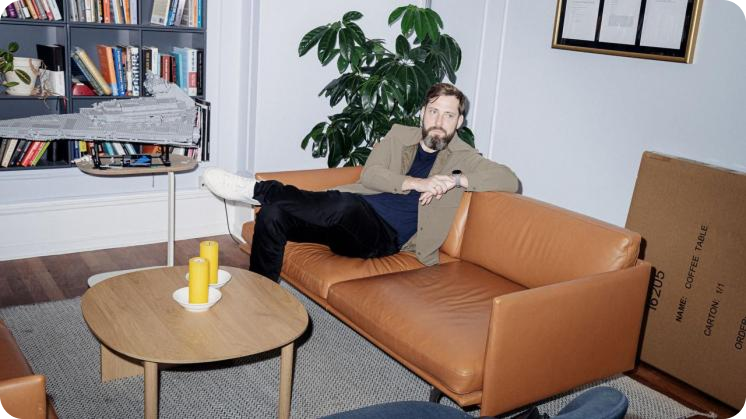
It is not that hard to be 45 and make good money.
What is hard is being 45, making good money, and also having a healthy family, a healthy body, a healthy mind, real friendships, a good romantic relationship, and a set of values you actually live by.
Most of us secretly know this. Still, we spend an absurd amount of time optimizing our businesses and almost no structured time investing in the one thing that sits underneath everything else. Our mind.
This is the story of how I learned to fix that. For myself first. And eventually, for others.
The first advisor that changed everything
In my early twenties I hit a wall.
I had always been the type who pushed through with effort. More hours, more intensity, more “I will just figure it out”. On paper I was doing well. Inside, I was not.
At some point depression crept in. I resisted talking to a psychologist for a long time. It felt like something “other people” did. Eventually I gave in, sat down, and started talking.
In one of those early sessions, I spent twenty minutes explaining why I couldn’t fire someone on my team. I had reasons, justifications, contingencies. He listened, then asked: “What would you tell a friend in this exact situation?” I answered in ten seconds. The fog lifted.
That moment was embarrassing and liberating at the same time.
Embarrassing, because I realised how much energy I had been wasting trying to solve everything alone. Liberating, because I got a taste of what it felt like to have someone in my corner whose only job was to help me think. I walked out of that session knowing exactly what to do on that messy project, which actions to take, and I could finally move on to the next problem instead of spinning on this one.
It was the first time I really understood this simple thing:
My mind is not an infinite free resource. If I treat it like one, I pay for it later.
That first advisor encounter planted a seed that would grow into something much bigger.
Building a real life personal advisory board
Over the next years I did something that, at the time, did not feel very strategic. I just kept adding people around me who could help me think better.
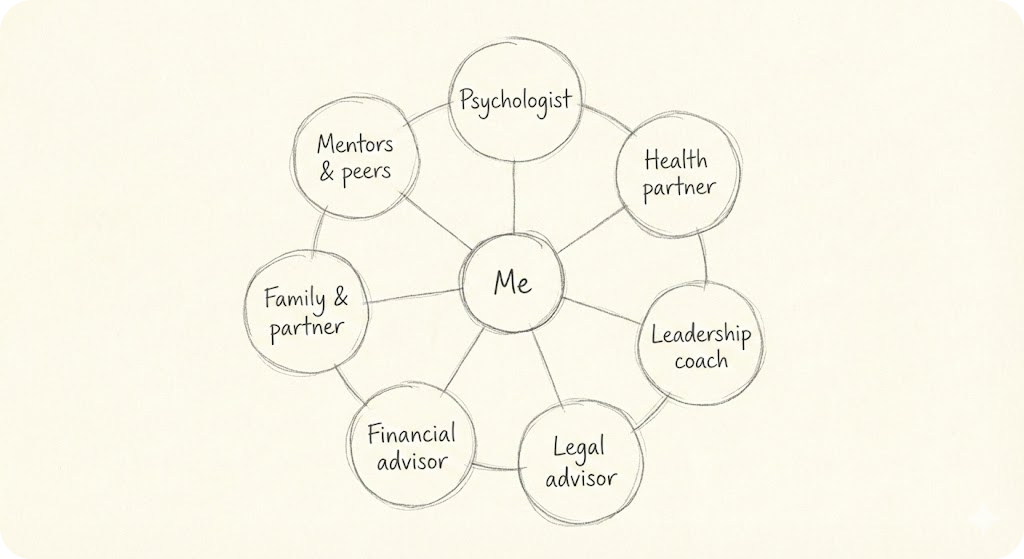
A psychologist for my inner life and relationships.
A health partner to run with, reflect with, and keep my body and energy in a good place.
A leadership coach to help me give feedback, grow teams, and grow up as a leader.
Later, a personal legal advisor to help protect the downside, and a personal financial advisor to help me think clearly about risk, security, and long-term bets.
Mentors. Fellow entrepreneurs. Close friends. People further ahead on the path. Over time, almost every important part of my life had at least one person I could lean on.
For context, I have been an entrepreneur for about twenty years, and my natural state is too many ideas, too much switching, and very little built-in handbrake.
I did not have the luxury of reinventing the wheel every time.
So this personal advisory board became my invisible infrastructure.
If I was stuck on a leadership problem, I would call the leadership coach and use their brain to sharpen my own. Sometimes I would even pull them into mentoring younger founders I had invested in, so they could grow their feedback muscles faster than I did.
If I was facing questions about family, difficult emotions, how to structure my life, or who I actually wanted to be, I would sit in my psychologist’s office and talk it through with him. He helped me sort things, see what really mattered, and understand the trade offs I was making.
Instead of being this heroic solo decision maker, I became the person who asks for help early. And that changed everything.
I stopped wasting cycles reinventing basic mental tools. I started reusing playbooks. I made better calls with less drama. Over time that translated into real outcomes:
A stable household. A strong relationship. Kids who are (mostly) okay. Healthy businesses. Good friendships. A mind that is still intense, but more anchored. A body that can keep up. A financial life that doesn’t feel like a constant emergency. And even some actual space in my life for rest and simple fun that isn’t just collapsing between crises.
The hidden lesson: your mind is the real compounding asset
Looking back, the pattern is simple.
Each advisor gave me mental models. Language. Ways of seeing. Those models did not disappear after one session, they stayed with me. They compounded.
We talk a lot about compounding capital as founders. We do not talk enough about compounding thinking.
When you invest in your own mind, everything else gets a little bit easier:
Decisions cost less energy
Conflicts become easier to navigate
You recover faster from setbacks
You can hold more complexity without burning out
Meanwhile, a lot of the founder culture is still obsessively focused on one narrow form of success. Revenue. Valuation. Headcount.
Making money by 45 is not actually the hard part.
The hard part is doing that and still liking who you are, still having a partner who trusts you, kids who feel seen, friends you did not sacrifice on the altar of “one more round”, and a body and mind that are not completely wrecked.
There is a version of this journey that I once described as a kind of ‘Faustian bargain’ - or ‘Deal with the Devil’ - for other entrepreneurs.
A lot of founders I’ve met – including myself – started out running on external fuel: money, status, approval, the need to prove something to someone. That “schoolyard strategy” works incredibly well in your early twenties. It gets you out of bad circumstances, helps you survive, sometimes even helps you win.
But eventually you have to pay the devil his due.
You’re no longer 22 with nothing to lose. You’re 35 or 45. You might have a partner, maybe kids, a team who depends on you. And the same strategy that helped you survive the schoolyard starts quietly wrecking your life.
The price is often a ruined relationship, burnout, depression, anxiety, or a constant feeling that whatever you build is never enough.
I’m one of the people who made that deal early on. It took me four to five hard years to shift from that external, proving mindset into something closer to inner motivation and self-compassion. To stop chasing only the scoreboard and start investing seriously in my own mind, values, and relationships. I’m probably still paying off some of the interest.
Building a life where you have money and also a healthy family, friendships, a body and a mind you can live with is not an accident. It is the result of investing in your inner infrastructure as seriously as you invest in your company’s infrastructure.
For me, that is the real root of Kin. It is not about productivity tricks. It is about building a system that helps your mind compound.
Who gets your secrets?
While I was building this advisory board in my physical life, a parallel question started nagging at me. One that would shape how we’re building Kin.
I have always been drawn to questions of autonomy and responsibility. In the physical world we take certain things for granted. You can own a home. You can own a piece of land. Countries have borders. Those borders create sovereignty. There are basic property rights that say “this is mine, you cannot just walk in and take it.”
I started to wonder why we do not think the same way about our digital lives.
Around the same time I was reading prominent libertarian thinkers, and watching the early crypto movement obsess over the same idea: people should be able to own their assets directly, instead of trusting large institutions.
It became clear to me that the same question would show up in our inner digital lives too.
Who owns your thoughts? Who owns your patterns? Who owns the very detailed psychological map that gets created when you pour your inner life into a tool?
We have spent a decade watching big platforms treat personal information like an extractive resource. It is very efficient. It also, in my view, feels fundamentally wrong on a human level.
So when large language models arrived and I started imagining what a truly personal AI could be, the trust question came up immediately.
If we’re going to build something that sits with you in your most vulnerable moments, that hears your doubts about your partner, your investors, your kids, your fears, your failures, then this cannot be “just another cloud product”.
It has to be built on the exact opposite logic.
Your data is yours. Stored locally by default. Encrypted. Portable. Editable. You are not the product. You are the owner.
That is not a marketing angle for me. It is the only way I can look myself in the mirror and still be proud of shipping this.
Why the existing tools were not enough
There are already great tools out there.
Therapists, coaches, group programs. I will always recommend them. They changed my life.
There are also great AI tools. AI Chatbots that can write copy, summarise documents, debug code, help you brainstorm. I use some of them every day.
But when I looked at what I actually wanted for myself as a founder and as a human, there was still a big gap.
I could not find anything that:
Felt like a long term, emotionally invested thinking partner, not just a transactional Q and A engine
Helped me connect dots across my life, not just across one project
Respected my desire for privacy and self sovereignty instead of hoovering up my inner life into someone else’s black box
I did not want a productivity machine. I wanted something that felt closer to that personal board of advisors I had built in the real world.
A place where different “voices” could help me see the same situation from different angles. Career. Relationships. Health. Values. And where all of that was grounded in knowledge about who I actually am and what I care about.
What Kin is today - honest 0.9 mode
So we started building Kin.
Not as some abstract AGI fantasy, but as a very practical, personal system that sits next to you in your real life.
Today, Kin is not a polished version 1. It is closer to 0.9. Rough edges included. Here is what it already does well.
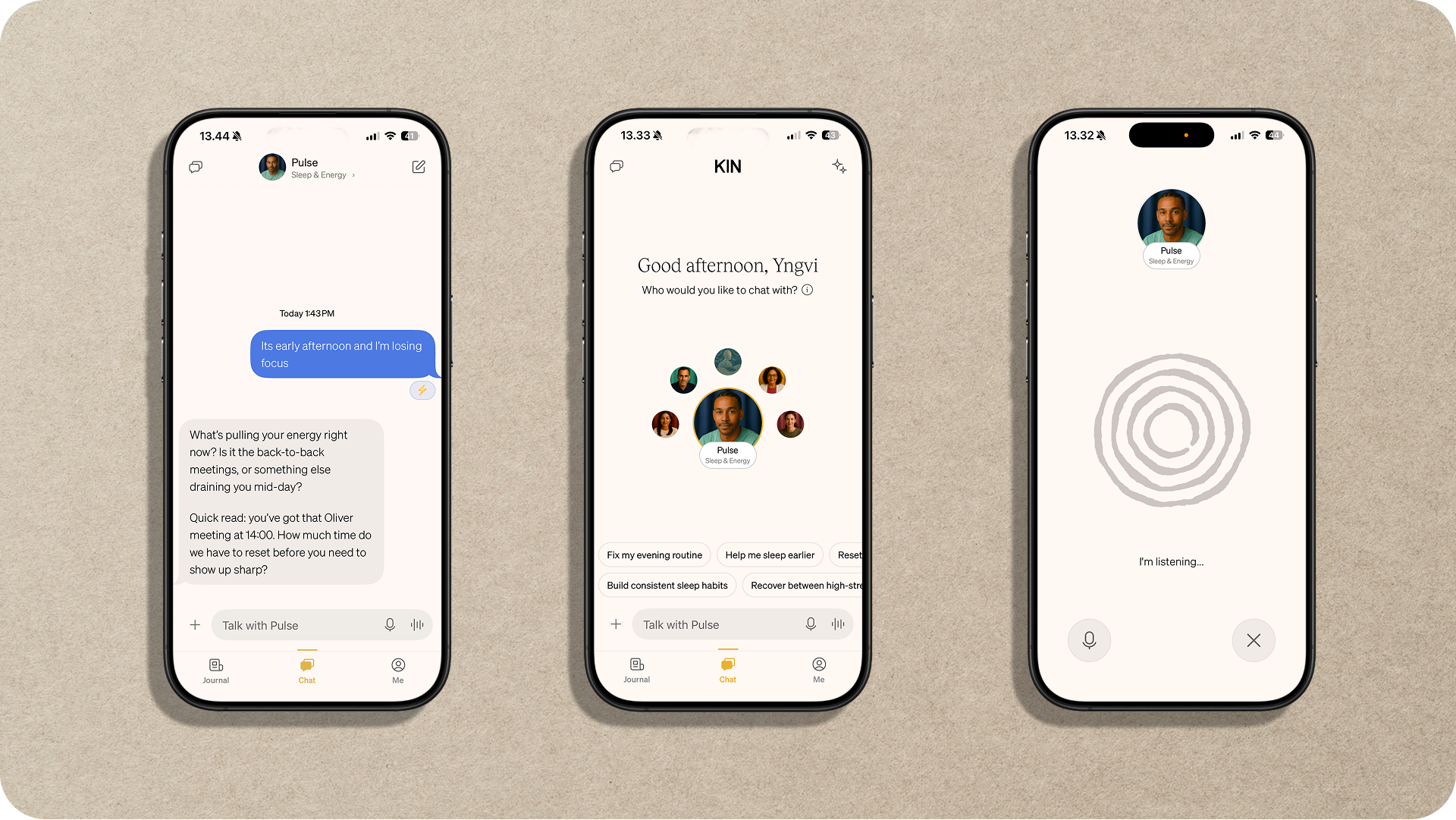
If you have used tools like ChatGPT, the difference you feel with Kin is that it does not just answer a prompt and move on. It remembers your world and thinks with you over time. It feels closer to a small advisory board than a single AI chatbot.
When I journal or debrief a day, it doesn’t just disappear into a chat log. I can talk to an advisor inside Kin about the entry and reflect on it, and Kin turns those moments into threads I can come back to later, so board meetings, product decisions, health issues and family situations build on top of each other instead of starting from zero each time.
Last Tuesday I woke up at 5:25, did my usual yoga, and then sat down with too many things in my head: investor follow-ups, a product decision that had been stuck for a week, and guilt about working all evening the day before.
I opened Kin. Pulse pulled in my low recovery score I shared from WHOOP, the back to back meetings directly from my Calendar, and the 2-hour padel session I had booked that evening and basically said: “This is not a hero day. Move one thing, lower the strain, and protect your evening.” It sounds small, but for me that is the difference between stumbling through the day and actually having something left for my family at night.
That’s the difference. Not productivity tricks. Thinking partners who know my patterns and help me catch myself.
Underneath all of this is a privacy first architecture. My data is stored locally by default, encrypted and under my control. My inner life is something to be protected, not mined.
Is it perfect? No.
Does it already feel, to me, like a meaningful extension of that advisory board idea into software? Yes.
Money, valuations and exits are fine. I still care about those too. But I no longer believe that is the real scoreboard.
Kin is what I’m building to make that a little bit easier. A private board of advisors that compounds with you over time.
The real scoreboard is whether you can build something meaningful in the world without losing yourself or the people you love in the process.
- Yngvi
If this resonates, you can find Kin here, and follow me on LinkedIn